 About
About Books
Books Articles
 Testimonials
 Daily
Daily Subscribe
Bookshelf
 |
Total GMAT Math Jeff's complete Quant guide, on sale now! |
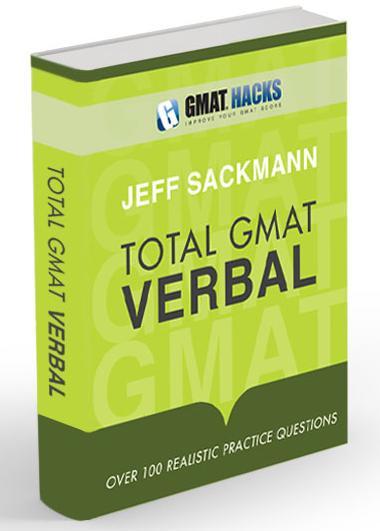 |
Total GMAT Verbal Everything you need to ace GMAT Verbal! |
1,800 Practice Math Questions
Buy Jeff's books at Amazon.com

GMAT Official Guide, with IR
OG Math | OG Verbal
OG12 & Quant Rev solutions!
GMAT Question of the Day
Beginner's Guide to the GMAT
GMAT Hacks Affiliate Program

Recent Hacks
Categories
- General Study Tips
- Goals and Planning
- CAT Strategy
- The Mental Game
- GMAT Math Strategy
- GMAT Math Topics
- Mental Math
- Data Sufficiency
- Critical Reasoning
- Reading Comprehension
- Sentence Correction
- Analytical Writing Assessment
- Integrated Reasoning
- IR Explained
- Business School Admissions
- GMAT Prep Resources
- Practice Questions
- Total GMAT Math
- Total GMAT Verbal
- GMAT 111

GMAT Critical Reasoning: Don't Take a Flying Leap
| You should follow me on Twitter. While you're at it, take a moment to subscribe to GMAT Hacks via RSS or Email. |
I frequently find myself in the position of listening to a GMAT student explain to me why he or she is absolutely, positively convinced that an answer choice is right–when, of course, it's not. That happens more on Critical Reasoning than any other section of the test, and I've discovered what brings many of those mistakes about.
The key concept, always, in CR questions is that of "scope." If an answer choice is too general or too specific, it is usually easy to spot as such. It's trickier when the scope is wrong, but not because it's too local or too global–it's just subtly shifted from the scope of the question. An example: The scope might shift from the effect of rainfall on the health of a certain species to the effect of rainfall on the growth of a certain plant that the species feeds on.
What to Watch Out For
When the scope shifts, it's perfectly natural to fill in the gaps for yourself. In the example above, you might think, "of course, if rainfall means that there's a more ample supply of this plant, then the species will have more food and be healthier." Depending on the question, though, that's the kind of rationale that gets you in trouble. Your job on CR questions isn't to devise justifications, it's to recognize them.
The difference is slight, but it's crucial. GMAT Critical Reasoning questions are very carefully written and designed. If a question means to say something, it will. Wrong answer choices are planned with equal care: there are no accidents in these questions. Questions that rely on inferences and assumptions (that includes those that ask you to strengthen and weaken arguments) expect you to understand the argument precisely. That means that all the information you need is right there in the question, and if you start making assumptions of your own, you're probably doing something wrong.
How to Avoid Making Assumptions
I'll be the first to admit it: it's hard to adjust to reading this way. Most writing, whether in interoffice documents or newspapers, is sloppy, and requires you to fill in the gaps. The GMAT doesn't. You will, over the course of your Critical Reasoning practice, make this mistake at least a handful of times–I guarantee it. But those mistakes are opportunities waiting for you to embrace them.
Through those mistakes, try to "watch" your own thought process so that you can catch yourself before you make another assumption. It is a distinct step in your mental process: you read the answer choice, you try to understand it, you see if it makes sense as the answer, and–perhaps–then try to figure out a way it could be the answer. That final step is where most people go astray: if you bring in explanatory material from outside the question, you've probably just made a mistake.
As with all other types of questions, when you get one wrong, carefully read the explanation and try to isolate what you did incorrectly. If you find yourself making assumptions, going beyond the scope of the question in Critical Reasoning, pay closer attention to your thinking as you analyze those answer choices that are "close, but not quite right." Usually, if it's not quite right, it's just plain wrong–you just need to recognize the shift in scope, or the leap in your own thought process.
This is one of the many common types of mistakes students make on Critical Reasoning questions. In the Total GMAT Verbal, I've identified many more common wrong answer choice types for both Critical Reasoning and Reading Comprehension.
About the author: Jeff Sackmann has written many GMAT preparation books, including the popular Total GMAT Math, Total GMAT Verbal, and GMAT 111. He has also created explanations for problems in The Official Guide, as well as 1,800 practice GMAT math questions.
|
|
Total GMAT Verbal
The comprehensive guide to the GMAT Verbal section. Recognize, dissect, and master every question type
you'll face on the test. Everything you need, all in one place, including 100+ realistic practice questions. |
