 About
About Books
Books Articles
 Testimonials
 Daily
Daily Subscribe
Bookshelf
 |
Total GMAT Math Jeff's complete Quant guide, on sale now! |
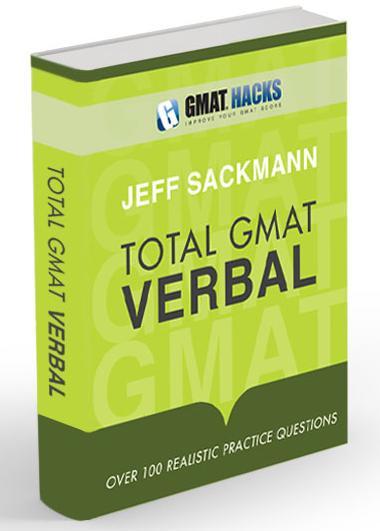 |
Total GMAT Verbal Everything you need to ace GMAT Verbal! |
1,800 Practice Math Questions
Buy Jeff's books at Amazon.com

GMAT Official Guide, with IR
OG Math | OG Verbal
OG12 & Quant Rev solutions!
GMAT Question of the Day
Beginner's Guide to the GMAT
GMAT Hacks Affiliate Program

Recent Hacks
Categories
- General Study Tips
- Goals and Planning
- CAT Strategy
- The Mental Game
- GMAT Math Strategy
- GMAT Math Topics
- Mental Math
- Data Sufficiency
- Critical Reasoning
- Reading Comprehension
- Sentence Correction
- Analytical Writing Assessment
- Integrated Reasoning
- IR Explained
- Business School Admissions
- GMAT Prep Resources
- Practice Questions
- Total GMAT Math
- Total GMAT Verbal
- GMAT 111

Using Sentence Correction Answer Choices
| You should follow me on Twitter. While you're at it, take a moment to subscribe to GMAT Hacks via RSS or Email. |
On GMAT Verbal much more than GMAT Math, the answer choices are a crucial part of the question. On Sentence Correction in particular, they can dictate your strategy.
As SC items get more difficult, it is tougher to tell from the initial sentence what the mistake is. (Or if there is a mistake at all.) Many test-takers redouble their efforts on the sentence, reading it three or four times in search of an error.
Because of the structure of the questions, every possible mistake is right in front of you. If there is a way the GMAT wants you to improve the sentence, it's in one of the answer choices. Take advantage of this!
Let's look at an example. Here are the answer choices from one question from the GMATPrep practice test question pool:
(A) had expected it to and its business will improve
(B) had expected and that its business would improve
(C) expected it would and that it will improve its business
(D) expected them to and its business would improve
(E) expected and that it will have improved its business
The answers--even out of the context of the sentence itself--give you plenty to work with. Here are just some of the issues:
- "had expected" or "expected?" Should the verb be past or past perfect?
- "it" or "them?"
- "will improve" or "would improve?" (Or "will have improved?")
- "and" or "and that?"
- "expected" or "expected...to?"
As is common on GMAT Sentence Correction questions, there are multiple errors in every wrong answer choice. You don't need to recognize every single one of them. In fact, as it turns out on this question, "had expected" and "and that" are both correct, making (B) the only possible answer. There are a lot of other ways to eliminate choices, so you don't need to puzzle out every grammatical possibility.
To be clear: I certainly don't mean to suggest you should thoroughly analyze the choices in every SC question, or that you should look at the choices before the sentence. There are plenty of questions on which you'll recognize the error(s) on the first read-through, and there's no reason to change your strategy.
Analyzing the choices, whether all five or just a couple of remaining choices, is a good backup strategy. Practice it, and take the pressure off of your careful reading of the sentence.
About the author: Jeff Sackmann has written many GMAT preparation books, including the popular Total GMAT Math, Total GMAT Verbal, and GMAT 111. He has also created explanations for problems in The Official Guide, as well as 1,800 practice GMAT math questions.
|
|
Total GMAT Verbal
The comprehensive guide to the GMAT Verbal section. Recognize, dissect, and master every question type
you'll face on the test. Everything you need, all in one place, including 100+ realistic practice questions. |
